How It Started
Tell me about the company. How did AgentBull get started?
The founder is Wang Yuqiao — he's our major shareholder. He comes from a family business background — traditional companies, not tech. He's very young and got very interested in AI and trading. He wanted to combine both. He brought in Boris — that's Ding Li, our CTO. Boris built the system architecture from scratch.
Which models are you building on?
We use Qwen from Alibaba as the base. Boris built our own smaller models on top — around 0.5 billion parameters. It took about three to four months for our first version, another three to four months of training to improve, and about two months ago we started running real money.
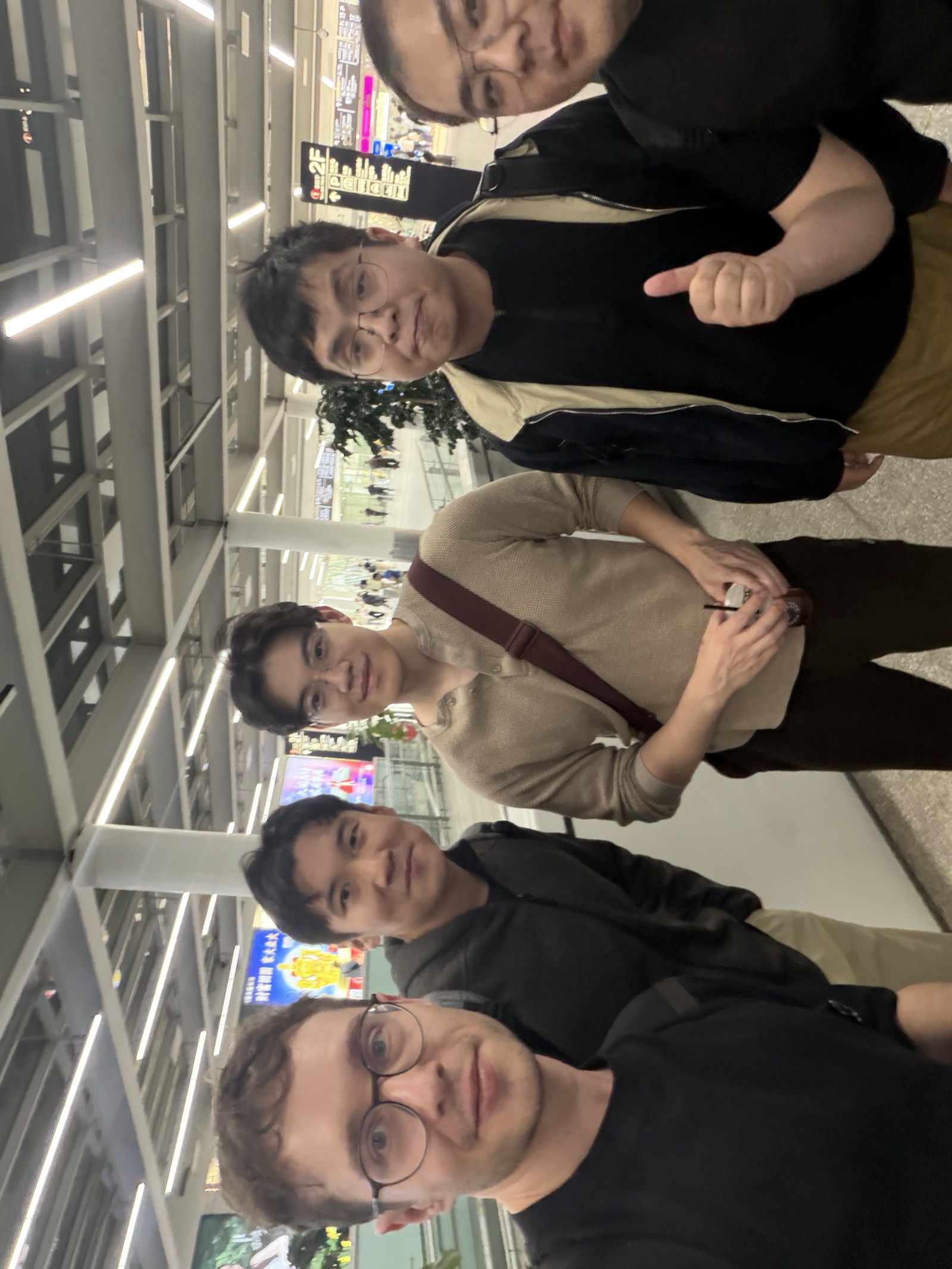
Boris adds (technical correction at the airport): "We primarily use Qwen. We also trained our own sub-billion-parameter models using RWKV-style non-linear attention architectures, mainly for handling long-context financial data. We use a multi-agent hybrid framework that chains different models together, where each model has different RLVR training objectives and reward directions."
Editor's note: AgentBull's architecture is fundamentally different from how Western quant funds like Two Sigma use LLMs. Western firms typically use models as one node in an existing workflow — e.g., for sentiment analysis. AgentBull runs the entire workflow end-to-end with language models, with RLVR reward signals training across the full agent chain. Boris argues this means the alpha they can discover is structurally different: rather than traditional quant signals, they're capturing "narrative economics" — identifying which market stories and narratives are dominant at any given moment, and predicting buy/sell decisions from the people who believe those narratives. Their site demonstrates this with examples like mapping a Tesla pre-market spike to Megapack storage margins (not car sales), then finding shadow A-share plays in temperature-control/PCS sectors.
Real Money, Real Market
How much are you trading with right now?
We have 2 to 3 million RMB running in the market right now.
And the rest of the capital — you're holding it back?
Yes. We're not sure the strategy is good enough for the full amount yet. You try for two weeks, and if the strategy isn't performing, you scale back, do more training, adjust the model. Then you try again. It's iterative.
You try for two weeks — if the strategy isn't good enough, you scale down, train more, and try again.
The Data Problem
What's your biggest challenge right now?
Data. That's the most important thing. We need high-quality trading data. If we had enough good data, we could put all our money into trading and make much more. But we're a new startup — the big funds that have been around for years, they share data with each other. We have to start from scratch.
Could you build free tools for retail traders and get their data in return?
We haven't tried this. But we need the data to be high-quality — trading decisions based on real rules, real strategies.
So you're basically trying to deduce what trading strategies bigger traders are using — spy on their behavior?
We'd like to, but it's very hard.
Boris adds (post-interview): "In many cases, data and compute are equivalent. With enough compute, you can obtain enough data — because the real bottleneck isn't the data source. There's massive amounts of OSINT and public data available, but it's buried in noise. Separating signal from noise is fundamentally a compute problem. So our strategy for expanding our data isn't to expand our data channels — it's to get more compute, and to improve our compute efficiency: how to process more data per unit of compute and extract different signals from it."
Fundraising & The 500 Million Hurdle
Who's investing in you right now?
Family office investors. Wang Yuqiao has connections — they've known each other a long time. Most of them have family businesses, property, inherited wealth they've grown. For them, 5 to 10 million RMB is simple money. They give us a try, and if they're happy, they give more.
Is there a turning point — a fund size where everything changes?
Maybe 500 million. That's the hurdle. Once you're at that size, other companies will take you seriously — potential data partnerships, cooperation. Below that, you're too small for them to care. At 5 billion, you get easy access to everything.
Chicken and egg problem.
Exactly.
Editor's note: This chicken-and-egg problem has a famous precedent. High-Flyer (幻方量化), one of China's largest quant funds, built a 100 billion RMB (~$14B) portfolio using AI — then in 2023 pivoted its research team into a standalone AI lab: DeepSeek. The lesson: China's quant trading ecosystem is one of the world's most competitive AI training grounds, and the talent/infrastructure built inside these funds can spin off into globally significant AI companies. AgentBull is at the early stage of this same trajectory — the question is whether a small OSINT-driven fund can cross the data moat that separates startups from the Mingshis and High-Flyers of the world.
What Investors Want to Know
When potential investors hear about AgentBull for the first time — what do they ask?
First: the trading track record. Real results, not backtests. Then: what data do you train on, and how do the models work? After that, our background — what did the team do before? And then comes the casual talk. Getting to know each other personally. It's very Chinese — you eat together, have drinks, build the relationship first.
AI Will Replace Work — But Not Yet
What should people know about what you're doing?
AI is very powerful and will take over a lot of work. But honestly — not yet. AI handles code and office applications pretty well, but for real-world decisions with real money? It's still not good enough on its own. We're one of the first companies using AI models to trade in a real market with real capital. I think it's a big opportunity for our generation.
Especially for people who are confident enough to learn AI and work with it — as a coworker, not a replacement. And that's what you do, right? You combine human judgment with AI systems.
Yes, exactly.
It's a big opportunity for our generation — especially for those confident enough to learn AI and work with it.
Boris Adds: From Sequoia's Radar to Trading Alpha
Boris, what did you actually do at Sequoia China, and how does it connect to what you're building now?
At Sequoia we focused on the primary market — VC investment. We built a complex knowledge graph connecting startups across multiple data dimensions, structured as a network with companies as nodes. Through multi-hop signals — looking across different nodes — we could discover interesting patterns. For example: if we observed that nearly all SaaS startups were suddenly hiring implementation consultants at scale — not just one or two companies, but across the entire industry — that was a signal of an industry-level shift. We used something like a radar system, scanning this network to detect both macro industry changes and micro company-level signals. Like noticing a company showing sudden business growth based on certain indicators, meaning there might be investment value, and we could move first.
And the plan beyond A-shares?
Right now, processing market data is very compute-intensive, so we're focused on A-shares. But from an algorithmic framework perspective, if compute and data sources can keep up, we'll expand to futures, US stocks, Hong Kong stocks — all markets. We already have US and HK data, but we haven't prioritized it. A-shares remain the core optimization target for our reinforcement learning pipeline.
Data and compute are equivalent. The bottleneck isn't the data source — it's the compute to separate signal from noise in massive OSINT.