The Shenzhen Hardware Guide That Locals Don't Want You to Have
I sat in a hardware workspace in Huaqiangbei and asked the engineers a simple question: Where's the guide for all of this? They laughed.
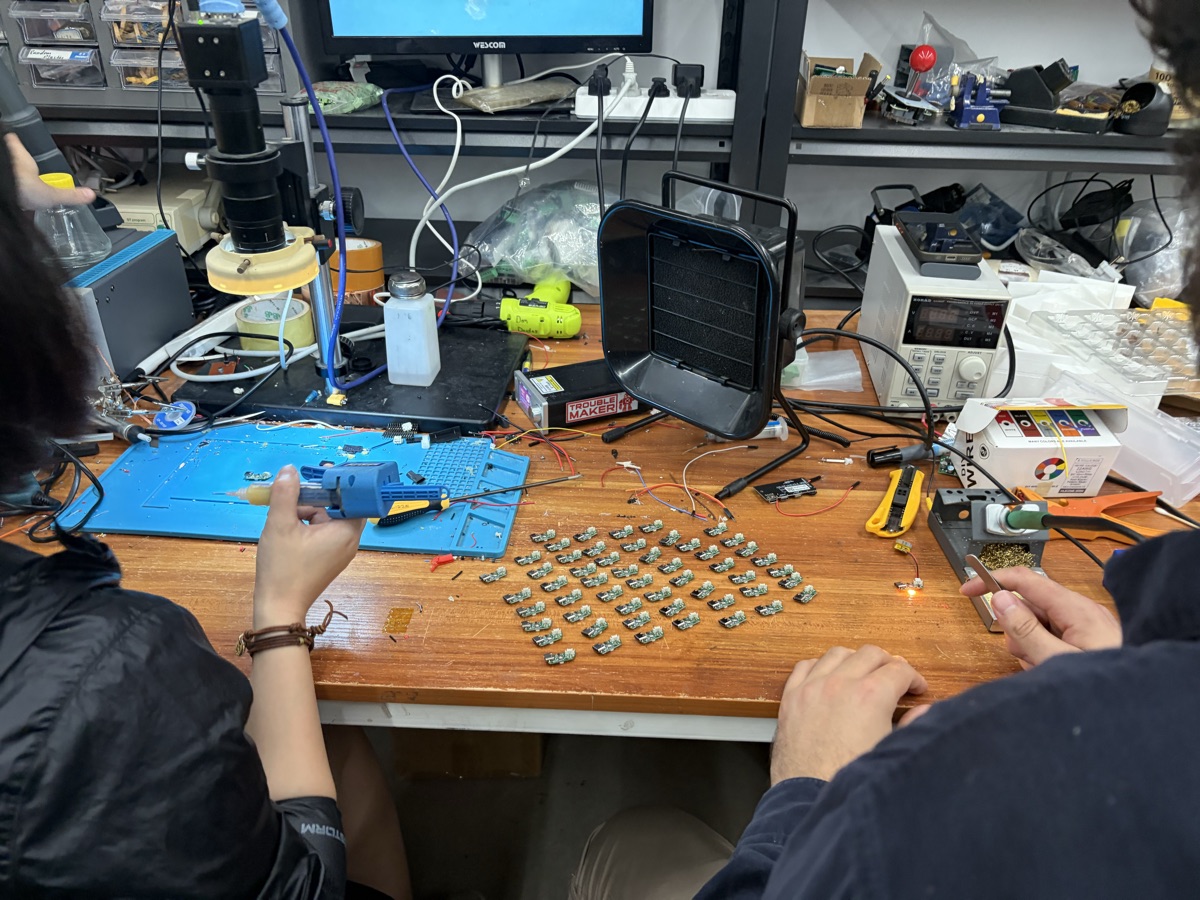
Inside the Troublemaker workspace in Huaqiangbei. Dozens of chips laid out, soldering station running, engineers programming components.
Here's the thing about Shenzhen's hardware ecosystem: the information exists. The factories exist. The engineers, the component markets, the prototyping houses. All of it exists. But there's no guide. No directory. No central platform where a founder can go and say: I need X built, show me my options.
I wanted to understand why. So I went to the Troublemaker workspace, a hardware-focused coworking space right in the heart of Huaqiangbei, and talked to the hardware engineers and entrepreneurs who work there.
What they told me explains everything about how Shenzhen actually works, and why most foreigners who come here either burn through their budget in a week or leave without getting anything made.
Why There Is No Guide
One of the engineers was programming chips at his desk while we spoke. Five chips. Twenty seconds each.
"There is a website that we call the secret website. It shows you what parts are in stock in Huaqiangbei. And he told me to not give the address to other people."
I asked if he was serious. He was.
The reason is simple: knowledge is margin. If you know which components are in stock, where to find them, and what they actually cost, you can charge a markup to the people who don't. The entire Huaqiangbei ecosystem runs on information asymmetry.
This is the opposite of how Silicon Valley works. In the Valley, the default is to put everything online, build a platform, disintermediate the middlemen. In Shenzhen, the middlemen are the platform. They carry the knowledge in their heads, in their WeChat contact lists, in years of relationships with factory owners.
So why doesn't someone just build the Alibaba of Huaqiangbei? I pushed on this.
The answer kept coming back to the same thing: there's not enough return on investment. Everything changes too quickly. And if you make it all transparent, you destroy the margin.
The closest things that exist are Taobao, Alibaba, and Made-in-China.com. They made a lot of money connecting Chinese factories to the Western world. But they're designed for bulk ordering, not for a hardware founder who needs 50 custom PCBs and an engineer who understands their schematic.
What Huaqiangbei Actually Is
Most articles about Huaqiangbei describe it as "the world's largest electronics market." That's like calling the New York Stock Exchange "a building where people talk about money." Technically true. Completely useless.
Huaqiangbei is a district, roughly 1 km by 1 km, containing dozens of multi-story buildings. Each building specializes. Each floor within each building specializes further. Each stall on each floor specializes even further.
The Key Buildings
- SEG Electronics Market — The most famous. Components, ICs, LEDs, connectors. This is where you go when you know exactly which part number you need.
- Huaqiang Electronic World — More finished products and modules. Arduino shields, dev boards, sensors, displays. Better starting point for prototypers.
- Mingtong Digital City — Phones, tablets, phone accessories. The refurbished iPhone capital of the world.
- SEG Science Park — Less market, more offices. Where the engineering firms and design houses set up.
But here's what the buildings don't tell you: the real deals happen on WeChat. You visit a stall, you scan a QR code, you add the vendor on WeChat. From then on, everything is negotiated in chat. Prices. MOQs. Lead times. Custom specs. The stall is the showroom. WeChat is where business happens.
The People You Need (And Why They're Hard to Find)
In a Western hardware startup, you have distinct roles: the hardware engineer who designs the PCB, the project manager who coordinates the supply chain, the sourcing specialist who finds the right manufacturer. In Shenzhen, these are often the same person.
"You basically need someone who is an engineer, at the same time a project manager, and also knows where and what to find. That type of person basically is a project manager in most of the tech companies here."
This is the key insight: the people who can help you the most are employed full-time at Shenzhen tech companies. They're not freelancing. They're not on Upwork. They're not looking for your project.
One of the engineers I spoke to recently started building an Obsidian database to map out the Huaqiangbei ecosystem: factories, capabilities, contacts. It's early days, but the intent is clear. He wants to eventually be able to sell that knowledge as a service. The fact that he's building it from scratch tells you everything about how fragmented the information is.
So How Do You Find Them?
The same way the locals do: in person, in the right spaces.
Hardware Spaces in Shenzhen
- Troublemaker — In Huaqiangbei. Small, serious, full of people who actually make things. Not a WeWork. More like a workshop with desks.
- x.factory — In Nanshan. Larger, more structured. Has CNC machines, laser cutters, 3D printers. Good for prototyping.
- HAX (SOSV) — The most well-known hardware accelerator globally. Alumni network is gold. Not easy to get into.
- Seeed Studio — Open-source hardware company that also runs community events and has connections across the ecosystem.
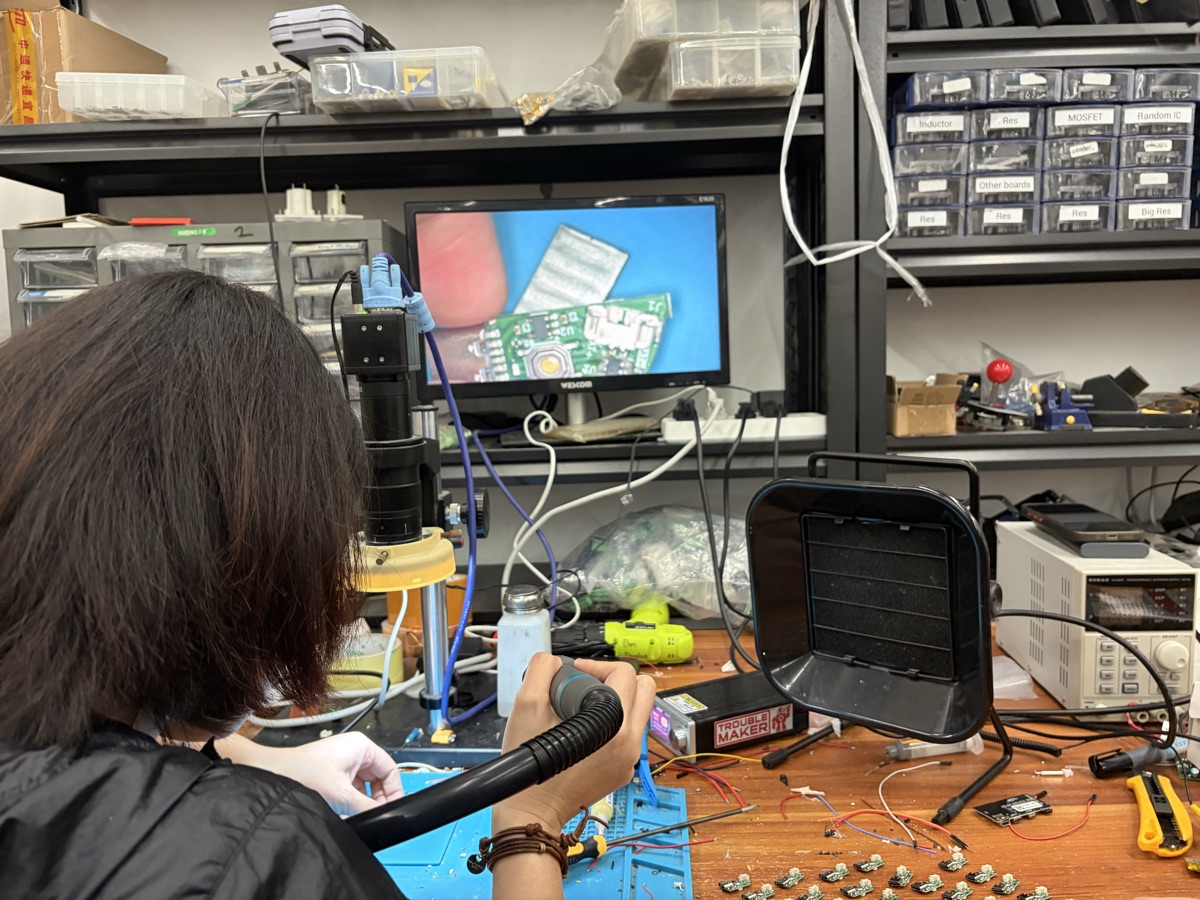
Soldering under a digital microscope. The PCB is magnified on the monitor behind her. This is the kind of work that happens daily at spaces like Troublemaker.
Show up. Hang out. Don't pitch. The people working at these spaces know more about the Shenzhen hardware supply chain than most consultants. But they wouldn't have talked to me if I'd sent a cold email. Being physically present is the filter.
What Things Actually Cost
Pricing in Shenzhen is contextual. The same PCB assembly can cost you $2,000 or $8,000 depending on who's quoting it, what your relationship is, and whether you walked into the factory yourself or went through three layers of agents.
How big is the difference? One engineer at Troublemaker told me he recently helped a client industrialize a product and saved them 50% on production costs, with his margin included, compared to what they'd been paying before. That's not unusual here. The gap between what a newcomer pays and what someone with relationships pays can be enormous.
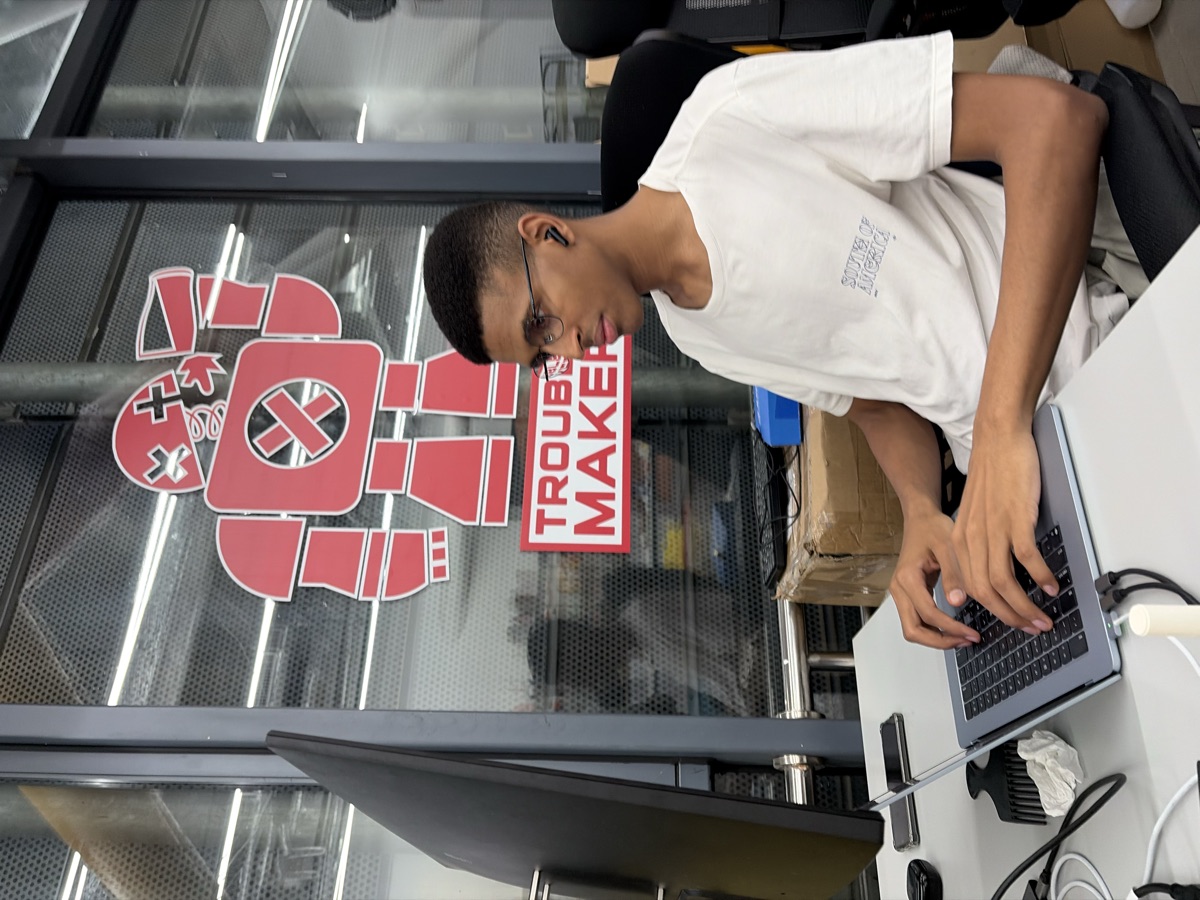
The coworking area at Troublemaker. Glass desks, the signature robot logo, and the kind of focused work that fills every desk here.
The markup isn't a scam. Agents provide real value: they translate (literally and culturally), they manage quality, they handle logistics, they take the risk of dealing with factories that might not deliver. But if you're serious about building hardware in Shenzhen, you need to understand that the biggest cost savings come from relationships, not from negotiating.
The Taobao Reality
When I pushed on why there's no centralized platform, the conversation kept circling back to one thing:
The consensus at Troublemaker: the closest things are Taobao, Alibaba, and Made-in-China.com. They made a lot of money making factories available to the Western world. But you're not going to find someone to reverse-engineer your PCB on Taobao.
Taobao handles the commodity layer: standard components, off-the-shelf modules, basic manufacturing services. But the moment you need something custom, something that requires engineering judgment, the platform breaks down. You need a person. And that person operates on trust, not on star ratings.
This creates a two-tier system:
- Commodity layer (Taobao, Alibaba, 1688.com): Standard parts, known specs, price competition. Foreigners can access this, but the UX is brutal without Chinese language skills.
- Relationship layer (WeChat, in-person): Custom work, engineering services, factory introductions. This is where the real value is, and it's invisible from outside China.
Your First Week in Shenzhen: The Action Plan
If you're coming to Shenzhen to build hardware, here's what your first week should look like. Not the tourist version. The version that actually gets you closer to making something.
Day 1-2: Set Up
- Stay near Huaqiangbei (Futian district). Walking distance matters. Budget hotels on the north side of Huaqiang Road start at ~$30/night.
- Get a Chinese phone number. You need it for WeChat Pay, which you need for everything.
- Get WeChat set up with payment. This is your operating system in Shenzhen. Not email. Not WhatsApp. WeChat.
- Download Taobao (淘宝) and 1688.com. Even if you can't read Chinese, start browsing your component category to understand pricing.
Day 3-4: Walk the Markets
- Don't just go to SEG. Walk the entire Huaqiangbei district: SEG, Huaqiang Electronic World, Mingtong, and the smaller buildings around them. Each has a different specialty.
- Take photos of everything. Stall numbers. Business cards. QR codes. Prices on display.
- Add every relevant vendor on WeChat. And take a selfie with every new contact. People change their WeChat profile pictures constantly, and after a week you won't remember who's who. The selfie is your anchor. (I learned this the hard way after my first month here.)
- Visit SEG Science Park to understand what engineering services and design houses are available.
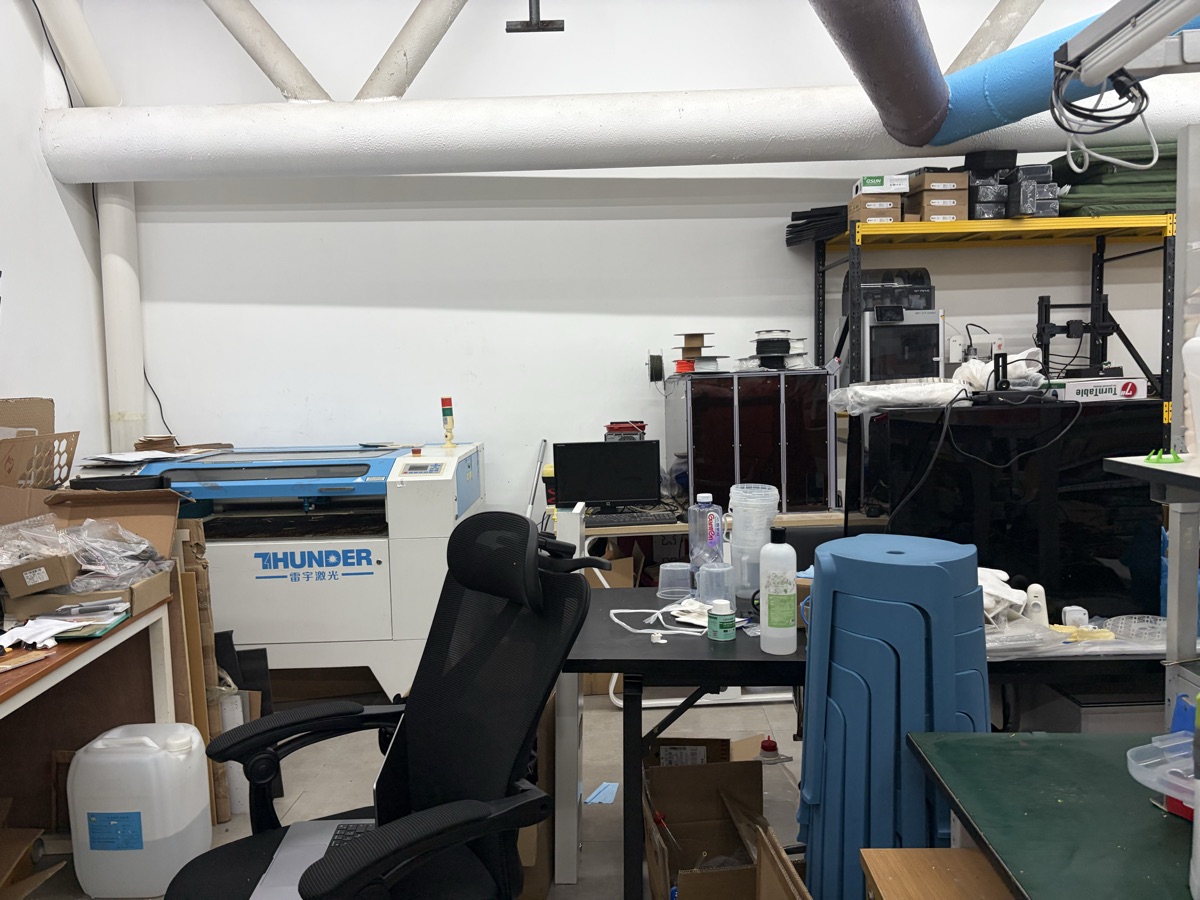
The workshop floor: Thunder laser cutter, 3D printers, and enough shelf space to prototype almost anything.
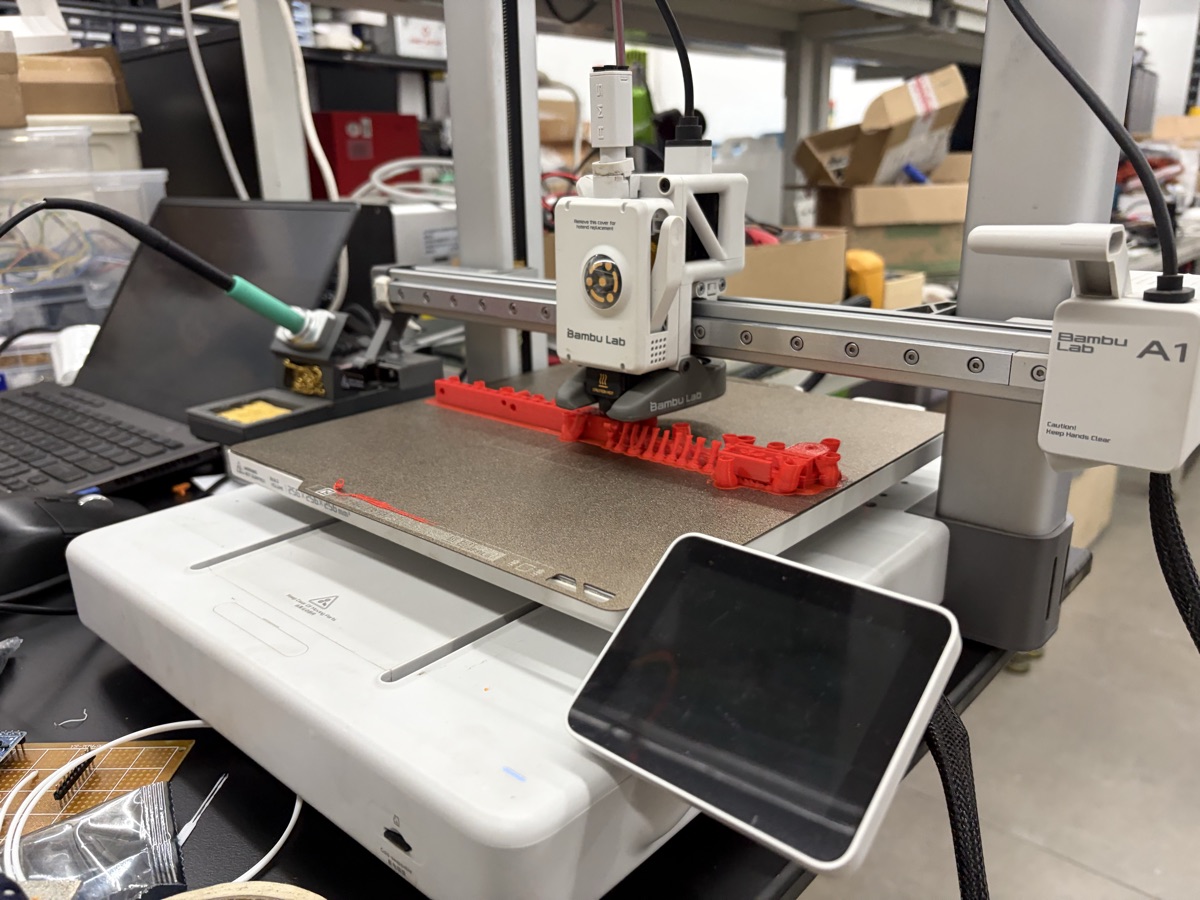
A Bambu Lab A1 printing prototype parts. From CAD to physical object in hours, not weeks.
Day 5-6: Find Your People
- Go to Troublemaker. Spend an afternoon. Talk to whoever's there. Don't come with a pitch deck. Come with a specific technical question.
- Prioritize finding foreigners who've lived here for years and run hardware businesses. They understand where you're coming from, they speak your language, and they know who to connect you with. Chinese engineers who work closely with Western clients are equally valuable.
- Check x.factory for events or open days. Join the Shenzhen hardware WeChat groups. Every space has one. Ask to be added.
- You can either pay for introductions (through a design house or sourcing agent) or you can earn them by showing up at community events. Those are realistically your two options.
Day 7: Reality Check
- By now you should have 20+ WeChat contacts, a rough understanding of pricing for your components, and at least one person who can introduce you to a relevant factory.
- If you don't have these things, you either stayed in your hotel too long or went to the wrong places.
The Uncomfortable Truth
The engineers at Troublemaker told me something that stuck: there is no shortage of hardware capability in Shenzhen. There is a shortage of engineers willing to freelance. Not because they all have cushy jobs, but because freelancing in Shenzhen hardware means being a full-stack entrepreneur. You can't just be a good engineer. You need to find your own clients, sort good projects from bad ones, source your own manufacturing partners, manage production, handle logistics. In Shenzhen, the expectation is that you do it all, from design to mass production.
That's why the few people who do this independently are rare and expensive. Most hardware founders end up working with European-based design houses that have Shenzhen operations, companies like Kickmaker or Casimir Engineering. They act as the communication and project management layer on top of the Shenzhen supply chain. You pay a margin, but one engineer I spoke to said he recently saved a client 50% on their production costs, his margin included, compared to what they'd been paying before.
The gap isn't information. It's access. And access in Shenzhen comes from being physically present, building relationships over time, and proving that you're serious about building something, not just sourcing cheap components for a weekend project.
The guide that locals don't want you to have isn't really a guide at all. It's a network. And the only way to download it is to show up.
Building Hardware in Shenzhen?
First Foreigner connects founders with the people and spaces that make Shenzhen's hardware ecosystem work. No agents. No platforms. Just introductions to the right people.
Learn More