How Luckin Coffee Beat Starbucks in China
Luckin Coffee went from scandal to 29,214 stores by making cheap, app-native coffee faster than Starbucks could respond. This is what I saw on the ground in China.
I was standing in a mall in Shanghai with a Luckin Coffee cup in my hand. On my left: Starbucks, warm wood, familiar logo, the global premium coffee playbook. On my right: Luckin Coffee, bright blue deer, pickup counter, phone-first speed.
They were not across town from each other. They were across the corridor.
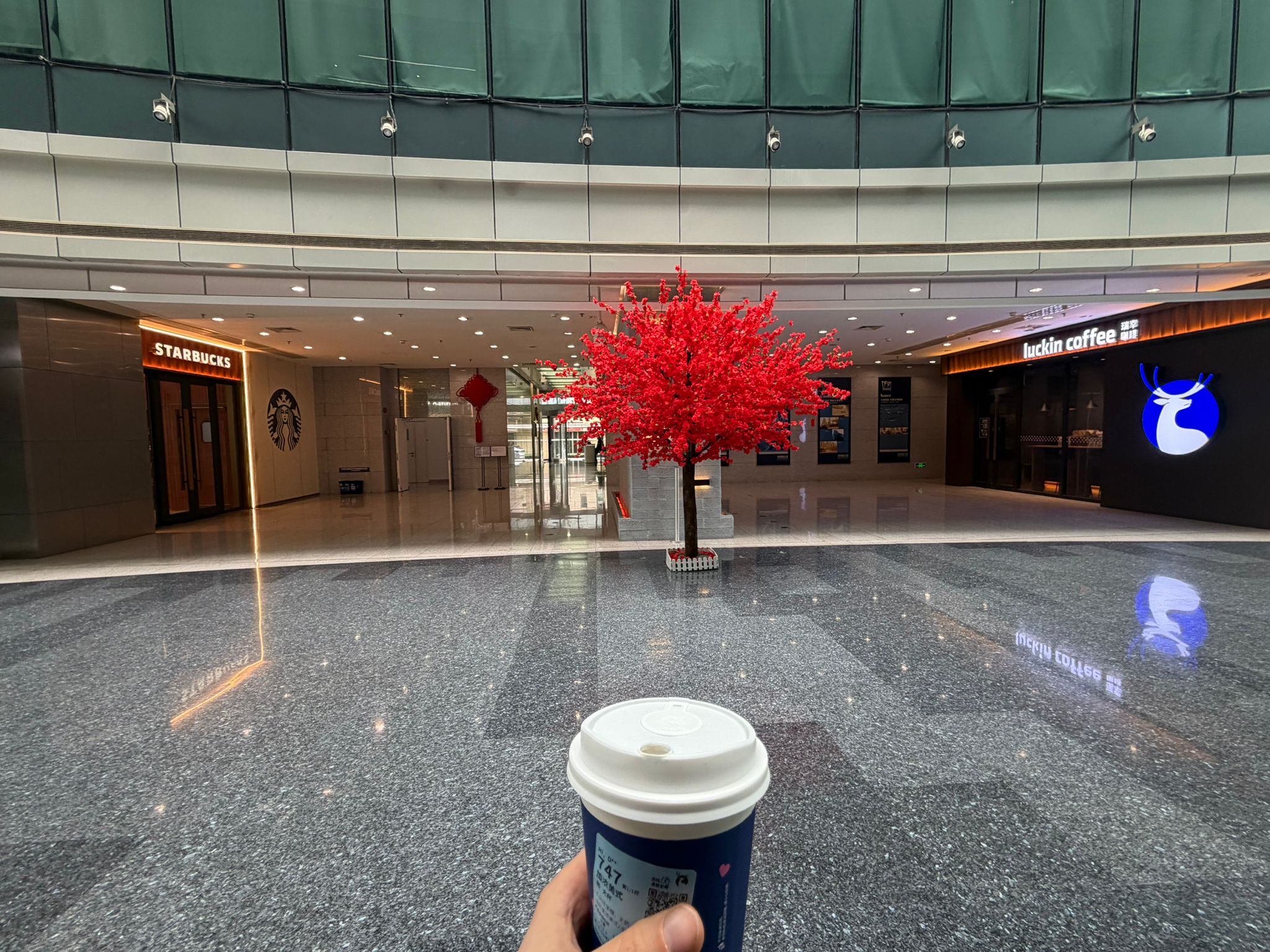
Shanghai, February 2026. Starbucks on the left, Luckin Coffee on the right. The photo is the strategy.
That image explains the Luckin Coffee vs Starbucks story better than any earnings chart. Starbucks taught China to pay for premium coffee. Luckin studied the habit, removed the ceremony, cut the price, moved ordering into the app, and put stores where the customer already was.
Then it scaled so fast that the old China playbook stopped working.
Luckin Coffee vs Starbucks in China: the short version
The simple version is this: Starbucks built the category. Luckin Coffee rebuilt the category for Chinese mobile behavior.
Starbucks arrived in China in 1999 and made coffee aspirational. A Starbucks store was not just a place to buy caffeine. It was a third place, a meeting room, a status signal, an imported taste.
Luckin did almost the opposite. It made coffee transactional.
No need to sit. No need to queue. No need to pay international-brand prices. Open the app, use a coupon, order a latte, pick it up, leave. If the drink is good enough and fast enough, the brand does not need to carry the whole experience.
By the third quarter of 2025, Luckin reported 29,214 total stores and 112.3 million average monthly transacting customers. Starbucks, meanwhile, had roughly 8,000 stores in China when it announced a new local joint venture structure in November 2025.
Those numbers are not perfectly apples to apples. Luckin’s store count includes overseas locations, although the network is overwhelmingly China-based. But the direction is not ambiguous. Luckin is now operating at a scale Starbucks cannot ignore.
The store next door was not an accident
The joke people make in China is that Luckin opened next to every Starbucks.
That is not literally true as a corporate rule. It is still directionally true as a strategy. Starbucks spent decades identifying premium urban coffee demand. Luckin could observe where that demand already existed, then attack it with a cheaper, faster, more digital format.
This is why the Shanghai mall felt so clear. Starbucks had the polished cafe. Luckin had the pickup machine. Starbucks asked you to inhabit the brand. Luckin asked you to tap twice.
The difference matters because China is not just a low-price market. It is a low-friction market.
Chinese consumers are used to app-native convenience: Meituan, Ele.me, Dianping, WeChat Pay, Alipay, mini-programs, live commerce, group buying. Once that behavior is normal, a coffee shop that still depends on a long line and a premium cafe ritual starts to feel slower than it should.
Luckin understood that the product was not just coffee. The product was coffee plus speed plus discount plus payment plus location density.
The price gap changed the meaning of coffee
The old Claude draft had the number that made the story emotionally obvious: a Luckin latte around RMB 9 to 10, versus a Starbucks drink in the RMB 30-plus range.
That exact coupon price moves constantly, so I would not treat it as a permanent fact. But the price architecture is real. Luckin trained customers to expect aggressive discounts, app coupons, and frequent promotions. Starbucks trained customers to expect a premium cafe.
In an emerging coffee market, that difference is powerful.
If coffee is a daily habit, price matters more than atmosphere. A RMB 30-plus latte is a meeting. A RMB 9.9 latte is a default. One is a place you go. The other is a thing you consume between two other things.
That is how Luckin changed the category. It did not need every customer to prefer the brand. It needed millions of customers to decide that “good enough, cheap enough, fast enough” was enough for Tuesday.
The app was the real storefront
Luckin’s physical stores are often small. Some feel less like cafes and more like logistics nodes with espresso machines. That is the point.
The customer relationship does not start at the counter. It starts in the app. The app controls:
- pricing and coupons
- ordering and payment
- pickup timing
- loyalty loops
- personalized offers
- delivery behavior
- new product testing
This is a very Chinese consumer internet pattern. The store is not the center of the experience. The phone is.
Starbucks also has a strong app, but the brand was built around the cafe. Luckin was built around the transaction. That made it easier to open smaller stores, push more promotions, run faster menu experiments, and treat each location as part of a dense fulfillment network.
The result is a coffee company that behaves more like a mobile commerce company than a traditional restaurant chain.
The scandal that should have killed Luckin Coffee
The strangest part of the Luckin story is that it should have ended in 2020.
In December 2020, the U.S. Securities and Exchange Commission said Luckin had intentionally fabricated more than $300 million in retail sales from at least April 2019 through January 2020. Luckin agreed to pay a $180 million penalty to settle the charges.
For most consumer brands, that would be fatal. For a U.S.-listed Chinese company, it was almost the perfect storm: accounting fraud, delisting pressure, investor anger, geopolitical suspicion, and a brand that was still young.
But customers do not experience a latte through a securities filing.
That is not a defense of the fraud. The fraud was real and serious. But it explains why the consumer business could recover faster than Western observers expected. If the app worked, the drink arrived, and the coupon was attractive, the customer had a reason to keep using it.
The market punished the company. The consumer did not punish the habit in the same way.
Why Starbucks changed its China strategy
In November 2025, Starbucks announced a major restructuring of its China business. It formed a joint venture with Boyu Capital, with Boyu taking a 60% interest in Starbucks’ China retail operations and Starbucks retaining 40% while continuing to own and license the brand.
That is not Starbucks “leaving China.” It is more interesting than that.
It is Starbucks admitting that China now requires more local operating leverage than a global headquarters can comfortably supply alone. Local competition is faster. Local landlords matter. Local supply chains matter. Lower-tier city expansion matters. The consumer context changes quickly.
Starbucks still has a valuable brand. It still has premium positioning. It still has a huge store base. But it is no longer the uncontested symbol of modern coffee culture. Luckin forced Starbucks to fight on terrain Starbucks did not choose: price, speed, density, and Chinese digital habits.
The joint venture is a strategic reset. It says: the brand remains global, but the operating model has to become more local.
What Western companies get wrong about China
The Luckin Coffee story is not really about coffee. It is about a mistake Western companies keep making in China: assuming that brand strength buys time.
It does not buy as much time as it used to.
In China, a local competitor can copy the visible part of the model, remove the expensive parts, localize the digital behavior, and expand before the incumbent has fully understood the threat. The local player does not need to be more prestigious. It needs to be more convenient.
You see the same broader pattern in other categories. BYD did not beat Western automakers by making electric cars feel more European. It built around batteries, vertical integration, and Chinese cost structure. Zheng Yuan Yuan did not ask whether Westerners understood Chinese foot care. It built a 9,000-store chain around a domestic service habit.
Luckin did the coffee version:
- find an imported behavior that is becoming mainstream
- remove the premium friction
- build the app layer first
- open densely
- discount aggressively
- test products quickly
- make the habit daily
That is the playbook.
The real lesson: good enough can be premium enough
Western consumer brands often assume quality wins. In China, quality still matters. But quality is only one variable.
The winning bundle is closer to:
good enough quality + better price + faster access + local digital behavior + cultural timing
That bundle is hard for premium incumbents to fight. If they lower price too much, they weaken the brand. If they keep price high, they lose daily frequency. If they move too slowly, local competitors use the delay as oxygen.
Luckin did not need every Starbucks customer. It needed to make coffee habitual for a much larger group of people who did not want the full Starbucks proposition every day.
And once a company has tens of millions of monthly transacting customers, the app becomes a testing machine. New flavors, collaborations, coupons, seasonal drinks, delivery pushes - everything can be measured quickly.
That is where the speed compounds.
Why this matters beyond Luckin Coffee
When I look at that Shanghai mall photo, I do not see a cute brand rivalry. I see the next decade of competition.
A Western incumbent identifies a profitable premium market. A Chinese challenger enters with lower price, faster iteration, denser distribution, and a mobile-native funnel. At first, the challenger looks cheap. Then it looks dangerous. Then the incumbent starts looking for a local partner.
This is not guaranteed in every industry. Brand still matters. Trust still matters. Premium still matters. But the Luckin Coffee case shows how quickly the center of gravity can move when the local model fits the local consumer better.
Starbucks gave China the coffee shop.
Luckin gave China coffee as infrastructure.
That is why the blue deer matters. It is not just another cafe logo. It is a reminder that in China, the company that wins is often the one that makes the experience faster, cheaper, and more repeatable.
The coffee does not have to be romantic.
It has to be there.
FAQ
Did Luckin Coffee beat Starbucks in China?
By store count and transaction scale, Luckin has clearly become the larger coffee chain. Luckin reported 29,214 total stores by the end of Q3 2025, while Starbucks had about 8,000 stores in China when it announced its Boyu Capital joint venture in November 2025.
How many Luckin Coffee stores are there?
Luckin reported 29,214 total stores at the end of Q3 2025, including 18,882 self-operated stores and 10,332 partnership stores. The company added 3,008 net new stores during that quarter.
Why is Luckin Coffee cheaper than Starbucks?
Luckin’s model is built around app ordering, coupons, smaller pickup-oriented stores, high density, and frequent promotions. Starbucks historically optimized for premium cafe experience and brand atmosphere. Those are different cost structures and different customer promises.
Was Luckin Coffee a fraud?
Luckin Coffee had a major accounting fraud scandal. The SEC said Luckin fabricated more than $300 million in retail sales from at least April 2019 through January 2020, and Luckin agreed to pay a $180 million penalty. That does not mean every store or drink was fake. It means the company’s public financial reporting was materially false during that period.
Is Starbucks leaving China?
No. Starbucks formed a joint venture with Boyu Capital for its China retail operations. Boyu takes 60%, Starbucks keeps 40%, and Starbucks continues to own and license the brand. That is a localization move, not an exit.
What is the main lesson from Luckin Coffee vs Starbucks?
The lesson is that China rewards speed, density, price innovation, and mobile-native convenience. A global brand can still be valuable, but it cannot rely on brand prestige alone when a local competitor makes the same habit easier and cheaper.
Sources
- Luckin Coffee Q3 2025 financial results
- Luckin Coffee Q2 2025 financial results
- SEC: Luckin Coffee agrees to pay $180 million penalty
- AP: Starbucks sells 60% stake in China business in $4 billion deal
- First-hand field notes and photos from Shanghai, February 2026.
Want more stories like this?
First-hand insights from China. No spam, no fluff.