The $2 Billion Molecule I Couldn't Pronounce
How China went from generic drugmaker to selling its own molecules to Western pharma. A doctor's field note on the $2B UBT251 deal with Novo Nordisk, the GLP-1 race, and China's drug-licensing boom, from the floor of a Chinese biotech fair.
Part of the reason I ended up in Shenzhen was a molecule I could not pronounce.
It is called UBT251. In early 2025 I read that Novo Nordisk, the company behind Ozempic and Wegovy, had licensed it from a Chinese drugmaker. The terms were the kind that make you read the sentence twice. Two hundred million dollars up front. Up to another 1.8 billion dollars if the drug hits its milestones. Roughly two billion dollars, in total, for an obesity molecule that had finished its first human trial and was only moving into Phase 2 in China.
Roughly a tenth is guaranteed cash. The rest only lands if the drug keeps hitting its development and sales targets. That split is the tell: Western pharma now writes nine-figure checks for Chinese molecules that have barely cleared their first human trial.
I am a doctor. I have watched the GLP-1 weight-loss drugs turn into the biggest story in medicine. So the part that stopped me was not the money. It was the direction. One of the most valuable drug classes in medicine, and one of its next candidates, had a Chinese address.
That did not fit the map most Europeans still carry. On that map, China makes the raw material, the West invents the drug. Novo paying two billion dollars to license a Chinese obesity molecule is the map being redrawn while nobody at home was looking.
I wanted to see where that happens. So I went.
The number I said out loud at a trade show
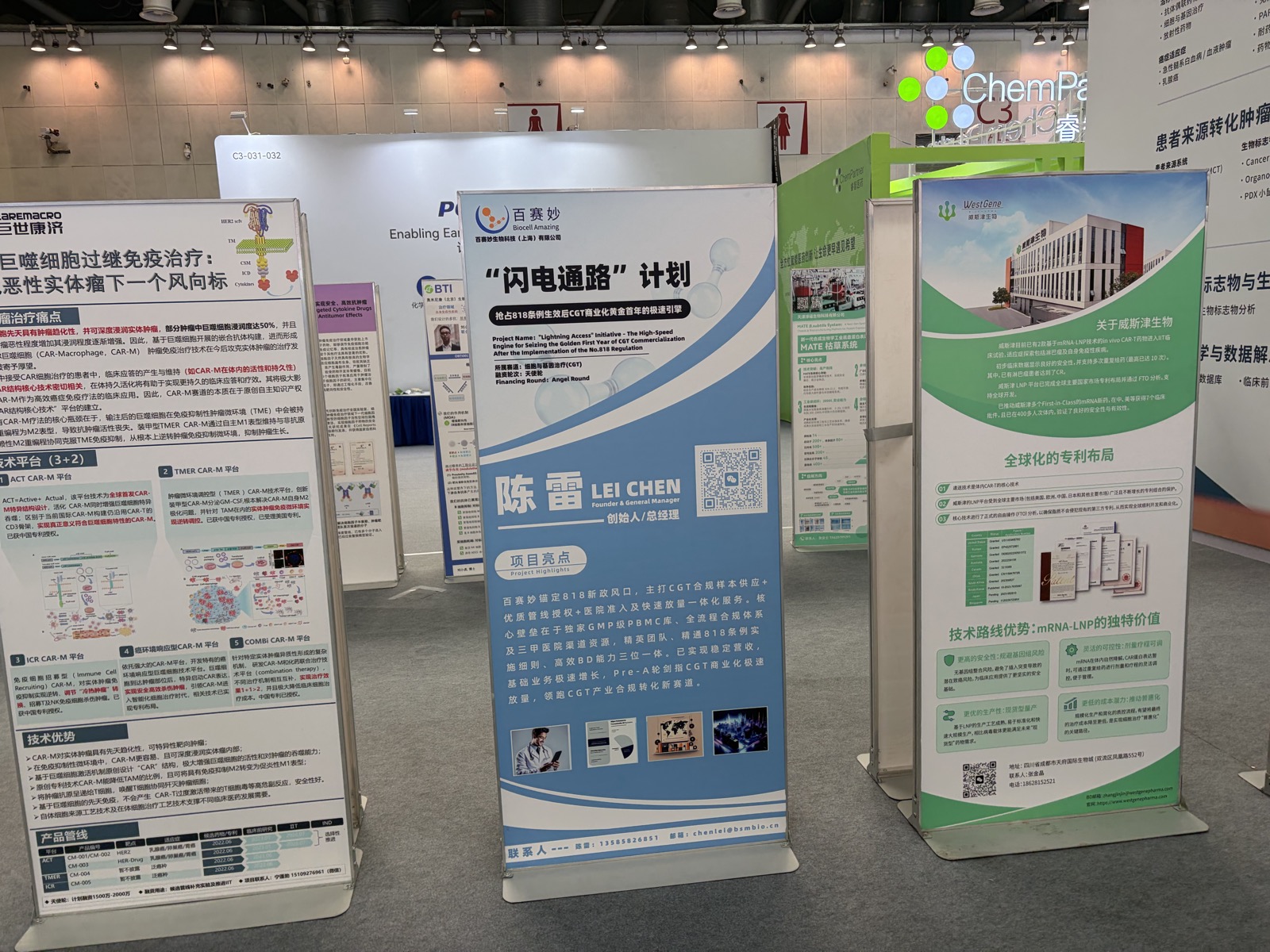
Later, I was on the floor of BIOCHINA, a biotech fair in Suzhou. I wrote separately about BIOCHINA as a China-Europe bridge in the making. This is the other half of that day, the part about the drugs themselves.
I was talking to a man from a contract manufacturer, one of the companies that actually makes and tests molecules for other people. He did biologics and antibody-drug conjugates, the complicated stuff. I was trying to understand a simple thing. If a Chinese company develops a good new weight-loss drug, how does it find a buyer in Europe or the US.
At some point I heard myself saying the UBT251 numbers out loud to him. Novo paid two hundred million dollars for it, I said, and up to another 1.8 billion if it hits its milestones. So they are clearly buying this stuff. There must be Chinese companies developing products here who need help finding the right buyers.
He nodded like this was obvious, because to him it was. He said something I kept thinking about afterwards. China now is the most licensed-out country in the world. The Americans especially, he said, they buy a lot of these assets from China.
I had walked in with the question. He answered it like it was old news.
From fast follower to seller
Here is the shift, and it is worth stating carefully because the lazy version of it is wrong.
The lazy version is “China used to copy drugs and now sells them.” That is not what happened, and it insults the actual work. For years Chinese pharma did three honest things well. It made generics at scale. It fast-followed, building its own versions of proven drug classes. And it became the workshop of the industry, the supplier and manufacturer that Western companies quietly depended on.
What changed is that Chinese companies started originating molecules that Western pharma wants to own, and licensing them out for real money.
The scale is not subtle anymore. Chinese out-licensing deals were worth around 28 billion dollars in 2022. By 2025 the figure was a record of roughly 136 billion dollars. In 2024, close to a third of the significant licensing deals big pharma signed, those with at least 50 million dollars paid up front, involved a China-originated molecule, up from about a fifth the year before and essentially zero five years earlier, according to DealForma figures. Stifel’s industry outlook put it the same way: roughly 31 percent of the innovative molecules large pharma in-licensed that year came from China.
And it is not only volume. In 2024, close to a third of Big Pharma's significant licensing deals, those with at least $50M paid up front, involved a China-originated molecule, up from about a fifth a year earlier and near zero five years before.
The word “supplier” no longer covers it. A supplier sells you capacity. What China increasingly sells is the asset itself, the molecule, the data package, the global rights outside its own borders.
GLP-1 made the shift visible
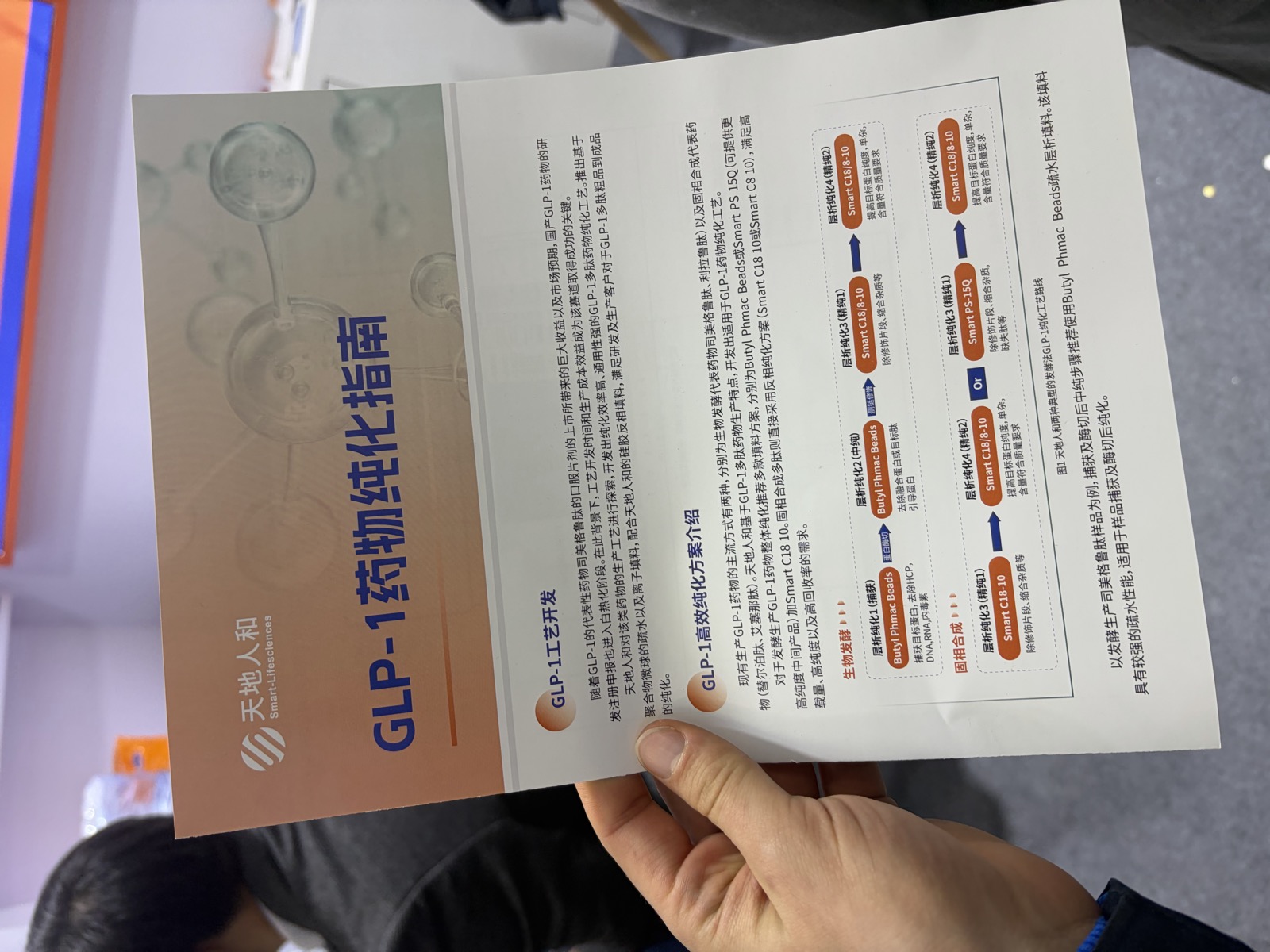
If you want to watch this happen in one drug class, watch the weight-loss drugs.
The Western reference points are Novo Nordisk’s semaglutide, sold as Ozempic and Wegovy, and Eli Lilly’s tirzepatide, sold as Mounjaro and Zepbound. Those are the molecules everyone else is measured against.
UBT251, the one that pulled me in, is a more complex design. It is a long-acting peptide that hits three receptors at once, GLP-1, GIP and glucagon, where semaglutide hits one and tirzepatide two. It comes from United Biotechnology, a subsidiary of The United Laboratories International Holdings Limited, a Hong Kong-listed Chinese company. Novo licensed the rights everywhere except mainland China, Hong Kong, Macau and Taiwan, which the Chinese side kept. In the highest-dose group of an early China trial, patients lost an average of 15.1 percent of body weight over 12 weeks, and a China Phase 2 reported in February 2026 later showed up to 19.7 percent mean weight loss after 24 weeks. Those are trial numbers from specific studies in specific patients, not a promise, and certainly not advice to take anything.
Semaglutide hits one receptor, tirzepatide two. UBT251 is a triple agonist, engaging GLP-1, GIP and glucagon at once. That is the kind of molecule Western pharma once built in-house and now licenses from China.
UBT251 is not alone, which is the actual point.
Jiangsu Hengrui, one of China’s largest drugmakers, took its own GLP-1 obesity portfolio and did something clever with it. In 2024 it licensed the assets into a new US company, later named Kailera Therapeutics, backed by American life-science funds. Hengrui took about 110 million dollars up front or near term, kept a 19.9 percent equity stake in the new company, and stands to earn up to 200 million dollars in development and regulatory milestones plus up to 5.725 billion dollars in sales milestones if things go well. Chinese biotech people call this the “NewCo” model. Instead of selling the drug outright, you keep a slice of the Western vehicle that develops it.
Then there are the ones China is developing and approving at home. Innovent’s mazdutide, a dual agonist licensed originally from Lilly, was approved by China’s regulator for weight management in 2025, described as the first of its kind cleared for that use. Sciwind’s ecnoglutide, partnered with Pfizer, was approved in China for weight management in early 2026. A domestic obesity-drug shelf is forming that did not meaningfully exist a few years ago.
And a cliff has already arrived that will make it louder. Semaglutide’s core compound patent in China expired on March 20, 2026, which opens the door to a wave of domestic semaglutide makers. By early 2026, around a dozen domestic semaglutide applications from roughly ten companies were already filed. The Western versions carry famous price tags, Ozempic near 936 dollars a month and Wegovy near 1,349 dollars a month at US list, and Novo itself launched Wegovy in China at a steep discount to that. I am describing a market structure here, not a shopping route. How anyone obtains these drugs is a medical question for a doctor, not something to reverse-engineer from a blog.
It was not a one-off
The reason UBT251 landed so hard for me is that once you see the pattern in obesity drugs, you see it everywhere. Oncology shows it even more clearly.
Akeso, a Chinese biotech, developed a bispecific antibody called ivonescimab and licensed the rights for several major markets to a US company, Summit Therapeutics, for 500 million dollars up front and up to 5 billion in total. Then the drug did something that got the whole industry’s attention. In HARMONi-2, a Phase 3 trial run in China and reported in September 2024, ivonescimab beat Keytruda head to head in first-line PD-L1-positive advanced lung cancer, cutting the risk of progression or death by about half, a hazard ratio of 0.51. Keytruda is the best-selling drug in the world. That result was from one trial, in one country, in one patient group, and the picture in other settings has been more mixed, so it is not the end of anything. But it was the first time a drug beat Keytruda that way, and it came out of China.
The deal list keeps going. Pfizer paid a Chinese company, 3SBio, 1.25 billion dollars up front for another bispecific antibody, with up to 4.8 billion more in milestones. Merck signed Kelun-Biotech for up to seven antibody-drug conjugates in a deal worth up to around 9.3 billion dollars. BioNTech, the German company behind the Covid vaccine, bought a Chinese biotech, Biotheus, outright, gaining a cancer antibody program.
Here is the same story as a table, which is the fastest way to see the shape of it.
| Chinese originator | Western buyer | Asset (type) | Reported deal value | Year |
|---|---|---|---|---|
| United Laboratories | Novo Nordisk | UBT251, GLP-1/GIP/glucagon triple agonist | $200M upfront, up to ~$2B | 2025 |
| Akeso | Summit Therapeutics | Ivonescimab, PD-1/VEGF bispecific | $500M upfront, up to $5B | 2022 |
| Jiangsu Hengrui | Kailera (NewCo) | GLP-1 obesity portfolio | $110M upfront + ~20% equity, up to ~$6B | 2024 |
| Kelun-Biotech | Merck | Up to 7 antibody-drug conjugates | Up to ~$9.3B | 2022 |
| 3SBio | Pfizer | SSGJ-707, PD-1/VEGF bispecific | $1.25B upfront, up to ~$6B | 2025 |
| LaNova Medicines | Merck | LM-299, PD-1/VEGF bispecific | $588M upfront, up to ~$3.3B | 2024 |
Read those buyer names again. Novo, Pfizer, Merck, BioNTech. These are not bargain hunters. The deals suggest they see enough in these molecules and their data packages to buy access rather than wait to build every comparable asset in-house.
How did China build its pharma industry?
The obvious question, standing on that trade show floor, was how. A country does not go from generics to selling molecules to Novo Nordisk by accident. From what I can piece together, it came from four things stacking up over about a decade.
One piece was regulation getting serious. Starting in 2015, China’s drug regulator forced a data-quality reset. Its “722 Notice,” issued on 22 July 2015, ordered companies to self-inspect the data behind 1,622 pending applications, and nearly 80 percent were withdrawn rather than face inspection. A backlog that had peaked around 22,000 applications in mid-2015 was nearly cleared by the end of 2017. China joined the main international body for drug standards, the ICH, that same year, and started accepting foreign trial data. The system went from a bottleneck to something a serious company could plan around.
Another was money. On 30 April 2018 the Hong Kong stock exchange opened its Chapter 18A, letting biotech companies list before they had any revenue, which is the norm for drug developers who spend years before a product exists. Hong Kong turned into one of the largest biotech fundraising venues in the world, and mainland China added its own tech board the next year. Chinese biotech could suddenly raise the kind of patient capital the science needs.
Then there were the people. A generation of Chinese scientists who had trained and worked in the US and Europe came home to build companies. The Chinese word for them translates roughly as “sea turtles.” Some of the most respected Chinese biotechs were founded by returnees who had spent years inside Western pharma and academia, and who came back knowing exactly how the global game is played.
And there was pressure, with a machine to relieve it. In 2018 China started buying generics through huge centralized tenders that crushed the margins on older generic drugs. If you were a Chinese drugmaker, comfortable generics stopped being comfortable, and innovation started looking less like a luxury and more like survival. At the same time the country had built dense biomedical clusters, places like Suzhou BioBAY, opened in 2007 and home to more than 430 companies, and Zhangjiang in Shanghai, founded in 1992 and now hosting more than 1,700 biomedical companies. Its clinical-trial system also runs faster and cheaper than the US or Europe. Direct trial costs can be 30 to 40 percent lower, and one late-stage lung-cancer estimate put the cost at about 69,000 dollars per patient in the US against about 25,000 in China, partly because care is concentrated in very large urban hospitals. That is a structural advantage in scale and organization, and it is a big part of why the data packages get built so quickly.
None of it is magic. It is a decade of fairly deliberate system-building, and it produced a country that can now sell the industry its next drugs.
Why this should matter to Europe
Here is where I stop being just an interested doctor and start being a German one.
The buyers in these deals are mostly American. Novo and BioNTech are the European exceptions, and BioNTech entered through a full acquisition. When Chinese biotechs go looking for a partner for a promising molecule, Europe is too often not in the room, or shows up only as a regulator and an end market rather than as a serious counterparty.
That was the gap I kept feeling at BIOCHINA. Chinese companies have assets and want access. Western companies want assets and worry about trust. Somebody has to translate Chinese clinical data, CMC files, audit expectations and global-rights language into a form a German due-diligence team can actually underwrite. That translation is a real job, and right now it is underbuilt on the European side.
I floated a half-formed idea on the floor, a BIOCHINA Europe, a place where this matchmaking could happen on European ground with European trust rules. I am not pretending that is a business plan. It is the shape of a question. If the next generation of drugs is increasingly designed in China and sold to whoever shows up with money and credibility, then not showing up is itself a decision.
The address of the frontier
I came to China with a vague sense that it was where things get made. I am leaving each BIOCHINA-style day with a sharper one.
The old map said China manufactures and the West invents. The newer map is less flattering to my side of the world. China now also originates molecules that Western pharma will pay billions to own, and it built the regulatory, financial and scientific machine to keep doing it.
A molecule I could not pronounce is part of why I moved here. Standing on that trade show floor, hearing a manufacturer treat China’s licensing boom as an obvious fact, I understood the trip had already paid for itself. The frontier of my own field has an address now, and for a while at least, it is going to be worth reading the mail from here.
Quick answers
What is UBT251? UBT251 is a long-acting peptide developed by United Biotechnology, a subsidiary of the Chinese company The United Laboratories. It is a GLP-1/GIP/glucagon triple receptor agonist for obesity and type 2 diabetes. In March 2025 Novo Nordisk licensed it for up to about $2 billion ($200 million up front) for all territories outside mainland China, Hong Kong, Macau and Taiwan.
Why is Western pharma licensing Chinese drugs? Chinese biotechs now originate molecules, not just manufacture them. By 2024, close to a third of big pharma’s significant in-licensing deals involved a China-originated molecule, per DealForma. For Western drugmakers, buying access to a proven Chinese molecule is often faster and cheaper than building a comparable one from scratch.
When does semaglutide’s patent expire in China? Semaglutide’s core compound patent in China expired on March 20, 2026. That opened the door to domestically made semaglutide; by early 2026, around a dozen applications from roughly ten
What is the “NewCo” model in Chinese biotech? A Chinese company licenses its drug assets into a newly created, usually US-based company backed by Western investors, and keeps an equity stake in that company. Hengrui’s 2024 deal that created Kailera Therapeutics is the template example.
Sources and further reading
I write these as field notes, but the numbers are checkable, and I would rather hand you the receipts than ask you to take my word for it.
- China’s out-licensing hitting a record of roughly $136 billion in 2025 (reported as high as $137.7B): PharmaSource, with the running deal-by-deal tracker at BioPharma Dive.
- Close to a third of Big Pharma’s significant in-licensing now coming from China, per DealForma and Stifel data: Nature and CNBC.
- Novo Nordisk’s UBT251 deal and the wider GLP-1 licensing wave (Hengrui/Kailera, mazdutide, ecnoglutide): the BioPharma Dive China licensing tracker.
- Semaglutide’s core China patent expiring on 20 March 2026: MLex and Morning Brew.
The weight-loss trial figures (15.1 percent over 12 weeks, up to 19.7 percent over 24 weeks) are from the specific China studies as reported, not pooled or averaged across trials, and should be read that way.
A note for journalists and editors. You are welcome to quote or cite this piece, and corrections are genuinely welcome. Reach me on LinkedIn or via the about page. Suggested citation: Dotzauer, D. (2026). The $2 Billion Molecule I Couldn’t Pronounce. First Foreigner. https://firstforeigner.com/articles/china-drug-licensing-ubt251/
Nothing here is medical advice or a recommendation to take, buy, or obtain any medication, including GLP-1 weight-loss drugs. Deal terms and trial figures are as reported at the time and are attributed to specific studies.
Want more stories like this?
First-hand insights from China. No spam, no fluff.