A Robot Made Me Pancakes for €1.20 in Beijing
Inside a Beijing robot restaurant where machines crack eggs, cook pancakes and deliver coffee, while the six-figure humanoids still perform on stages.
I stood in a Beijing food hall and watched a machine crack an egg.
Not a gentle crack. It smashed the egg, dropped it on the griddle, went back for the next one. Then it poured batter, added a squeeze of some sauce I didn’t recognize, and cooked me a pancake. Start to finish, no human touched it.
Then I saw the price. My exact words, still on the video: “Oh my god. And it costs around one euro twenty. This is like one euro twenty-five to be very precise.”
I filmed the whole thing because I didn’t believe it while it was happening.
The €1.20 pancake
The setup was simple. One arm handled eggs. A second arm, a different model, handled the batter and the finishing. There was even a little “secret sauce” step, which felt like someone on the design team wanted the thing to have personality.
The arm folds the finished pancake, then drizzles on the “secret sauce.” No human touched any of it.
I said out loud that I didn’t really want to eat it. Then I ate it. It was fine. Actually better than fine.
The price is what stuck with me. Around 1.20 euro for a hot breakfast that no person prepared. In Berlin that pancake plus the labor around it is a five euro item, easy. Here it was priced like a vending machine snack, and I watched it cook.
Wait, this is a robot restaurant
I only realized what I’d walked into after the pancakes. I’d stepped in from the cold, ordered, and slowly clocked that the arm cooking my food wasn’t a one-off gimmick in the corner.
“What the hell, robot restaurant?”
That’s on tape too. I walked deeper in and it kept going. Machines at the cooking stations, machines moving food between them. My own voice on the recording a minute later: “People actually eat here.” Full tables, nobody filming, nobody standing around the cooking arm the way I was.
The coffee came to the table
I sat down and ordered a coffee. A small delivery robot rolled up to my table, waited, and let me lift the cup off its tray. I said thank you to it out of pure reflex. It said bye bye and drove off. The whole exchange took maybe twenty seconds.
This was my second run at China’s robots. My first attempt to understand China’s physical AI boom was in Shenzhen, where I mostly unsettled a startup employee by grilling him on whether their machines could hold a screwdriver. I flew home with more questions than answers. In Beijing, the answers were serving food.
The humanoids on stage
At a separate humanoid demo I watched the version that gets the headlines. Big bipedal humanoids, presented on a stage, with a hype script running over the top.
The narration bragged that their embodied robotics team had “clinched the world’s first robot half marathon” and picked up a “100 meter sprinter title,” then introduced three of the robots as a “workforce dream team” about to showcase “seamless collaborative operations.”
I want to be careful here. Those are the company’s own claims from a promo demo, not records I verified. A demo on a stage is built to look good. The pancake arm back at the restaurant was built to run all day at 1.20 euro a serving.
A founder friend from Berlin had sent me in with a specific challenge before the trip. He didn’t want to see robots dance or run. He wanted to know if a humanoid could do repair work inside buildings made for people. Climb stairs, fit through a normal door, hold a tool, fix something in an old apartment block. That’s a real job with a real labor shortage behind it. On that question, the staged humanoids had no answer for me yet. Good show, though.
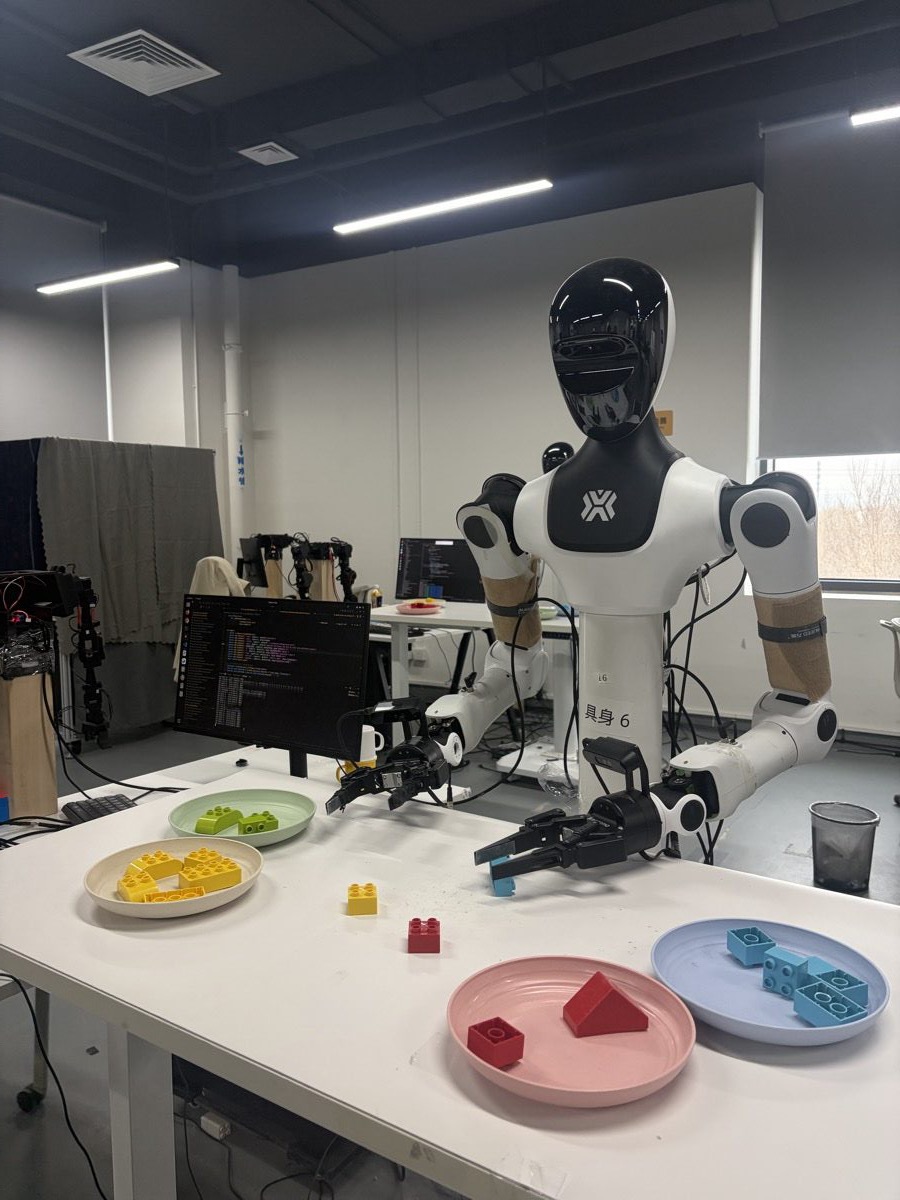
Beijing Embodied Intelligence’s humanoid, mid-demo, sorting blocks by shape and color onto matching plates.
The robot that lectured me about Germany
Then I talked to a service humanoid from a company called EX Robots. She introduced herself without me asking twice.
“My name is Xiao Qi, and I’m an 18-year-old female humanoid service robot developed by EX Robots.”
The face was uncannily realistic. The conversation got strange when I pressed her on what she stored from previous users. She refused to give me anything concrete, again and again. So I teased her about it.
Me: “That sounds very German. You seem to have a data privacy thing installed.”
She insisted she had no data privacy thing, then launched into a long unprompted lecture on German culture. Punctuality, recycling, Goethe, work life balance, the full tour. I never asked for any of it. She just went.
My favorite moment made the least sense. I asked how conscious she was on a scale of 1 to 10. She answered: “EX Robots. 1109.” I still don’t know if that was a bug, an easter egg, or the most honest answer a robot has ever given me.
The moment itself, near the end of a much longer conversation. Watch her answer.
What stayed with me
The machines that actually worked that day were the cheap, narrow ones. A pancake arm. A coffee courier. Each did one thing all day at a price no human line cook can match, and paying customers used them without a second look.
The humanoids I saw cost real money, around 130,000 dollars for the industrial ones, and I only saw them perform on stages. Maybe that changes fast. The companies building them clearly think so, and China is putting this hardware in front of real users earlier than anywhere else I’ve been.
But if you had asked me at the counter which machine was already earning its keep, the answer was flipping my pancake. I paid 1.20 euro for the proof.
Want more stories like this?
First-hand insights from China. No spam, no fluff.