The Door America Is Trying to Close on Chinese Drug Data
Did the FDA stop accepting Chinese clinical trial data? A doctor on the sintilimab precedent, the FDA's real position, and the 2026 push in Congress to ban it.
A friend sent me a voice message that nagged at me just enough to look into it.
He is a biotechnologist, so when he reacts to something I wrote about drugs, I pay attention. He had just read my piece on China’s biotech boom from the day before, and it reminded him of something on the spot. He wanted to pass on what a colleague of his had said, a man he trained alongside during his doctorate who now works in pharma market access, the part of the industry that gets drugs approved and paid for. That colleague had told him something that sounded, at first, like the whole story flipping over. The FDA, he said, does not accept clinical trial studies from China anymore. The reason he gave was blunt. The Chinese are bringing so much to market that the Americans are afraid of losing the race, so they are pulling up the drawbridge.
The reason I bothered is that if it were literally true, it would undo half of what I had just written. The day before, I had argued that China now originates the molecules Western pharma pays billions to license. If the American regulator had simply stopped reading Chinese data, the boom would have a ceiling nobody was talking about.
So I went and checked. And the answer is more interesting than the rumor, which is usually how these things go. The rumor was wrong on the mechanism and right on the mood.
What is actually true
The FDA has not banned Chinese clinical data. It could not do that with a memo even if it wanted to. American drug rules have always allowed clinical data from anywhere in the world, as long as it meets the agency’s standards. There is nothing sneaky in that. It is how modern drug development works. Almost every new drug application the FDA reviews leans heavily on trials run outside the United States. The large majority of patients enrolled in FDA-regulated trials are not American, by some counts close to nine in ten. A wall against foreign data would be a wall against the way the whole industry already runs.
What the FDA has done is narrower and sharper. It has pushed back, hard, against approvals built on data from one country only, and in practice that has meant China.
My friend heard the 2026 mood and assumed it was already 2026 law. It is not. But the direction of travel is real, and it has been building for years.
The sintilimab case that started it
The moment the industry points to happened in early 2022, and it involved an American giant.
Eli Lilly had partnered with a Chinese company, Innovent, on a cancer immunotherapy called sintilimab. They took it to the FDA for lung cancer, and the trial behind it, called ORIENT-11, had been run entirely in China. In February 2022 the FDA convened its oncology advisory committee, and the committee voted 14 to 1 that Lilly and Innovent should run additional trials before the drug could be approved for American patients. The FDA declined the application shortly after.
The objection was not that Chinese scientists do bad work. It was a question that sounds dry until you sit with it. Does a trial run in one country, in one population, under one standard of care, tell you what a drug will do in a different country with different patients and different alternatives already on the shelf? The FDA’s long-standing preference is for what it calls multi-regional trials, studies that enroll patients across several countries, including the United States, so the result travels. A drug tested only in Chinese hospitals, on Chinese patients, against whatever was standard in China at the time, is a narrower claim than it looks.
There was a second, quieter concern underneath it. Some of these China-only trials were being run without an American application open at all. A company could conduct the whole study in China, outside the FDA’s view, and then arrive at the end with a finished data package and a pitch: approve this, and we will sell it cheaper than anything you have. The FDA did not love being handed a completed test it had never been allowed to help design.
So the real 2025 position, the one my friend’s colleague was half-remembering, was not “we reject Chinese data.” It was closer to “bring us data we helped design, that includes patients like ours, or do not be surprised when we say no.”
Where the rumor was right
Here is the part I did not expect, and the reason I keep coming back to that voice message. My friend’s colleague had the mechanism wrong. But he had the temperature exactly right.
Because in 2026 the conversation stopped being only about science. It became about power.
On April 29, 2026, the House Appropriations Committee advanced its funding bill for the FDA, and tucked into the report language was an instruction that would have been unthinkable a few years earlier. It told the FDA to stop accepting, reviewing, or even considering clinical trial data generated at sites in China, Russia, Iran, or North Korea when companies apply to start new drug trials in the US. Not “weigh it carefully.” Not “require US patients too.” Stop looking at it. The provision, pushed by Representative Andy Harris, would take effect a year after the bill became law.
That is a different argument than the one from 2022. The 2022 argument was about whether the data was applicable. The 2026 argument groups China with three adversary states and treats the data itself as a national-security problem, something to be walled off rather than evaluated. It sits alongside the BIOSECURE Act, a bill that would cut named Chinese biotech firms out of US federal contracts, and a broader push in Washington to untangle American biotech from Chinese partners.
I want to be careful and honest about the status, because this is exactly the kind of thing that gets exaggerated into “the FDA banned China” in a group chat. As of now it is report language, not binding law. It rides on a bill that still has to clear the full House, then the Senate, then a reconciliation process, and language like this often falls out along the way. It may never take effect in this form. But it was written, by a committee, and put on the record. The instinct my friend relayed, that Americans are getting frightened enough to reach for the drawbridge, is not paranoia. It is on paper now.
Why they would be nervous
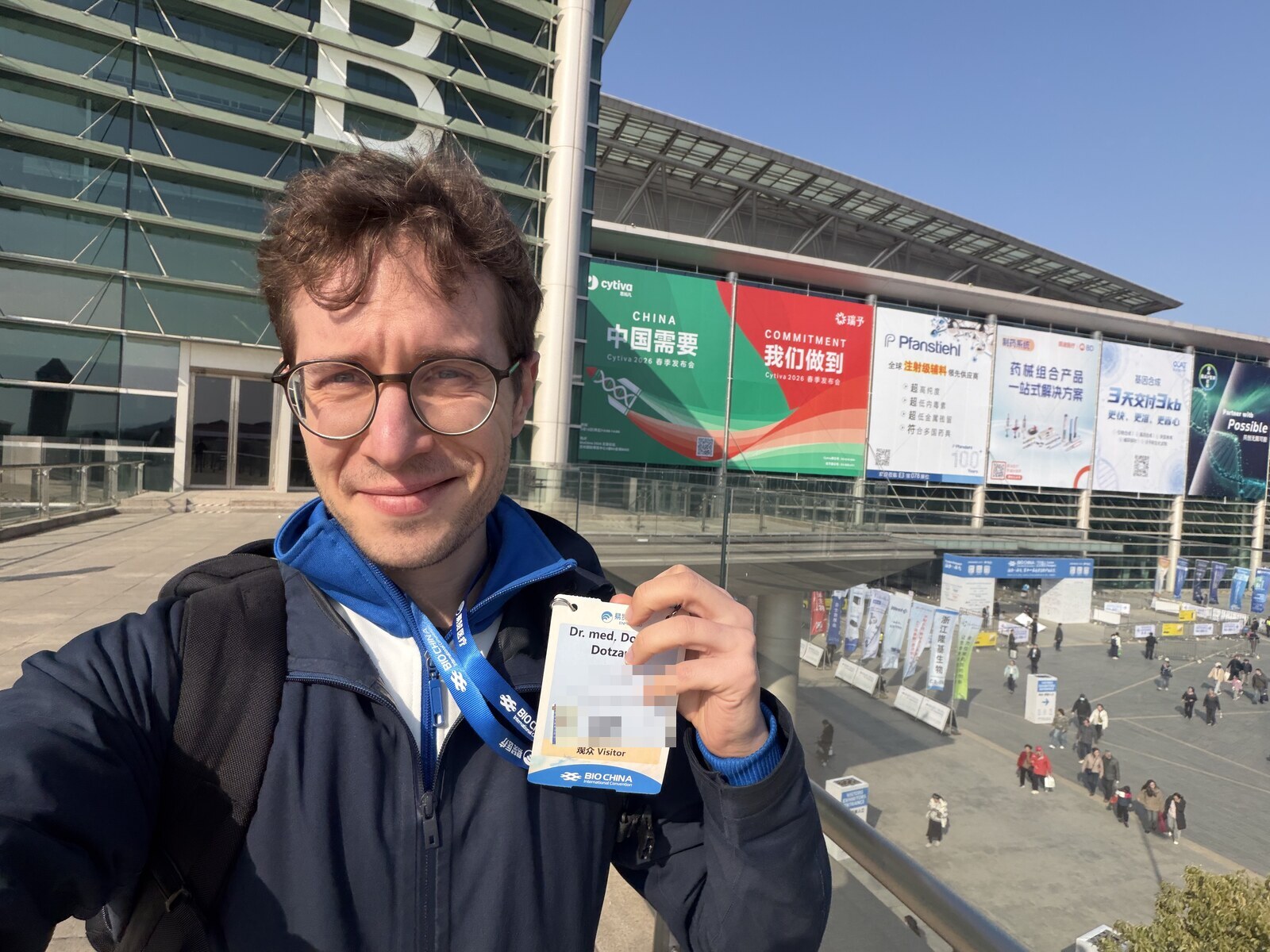
Stand where I stood earlier this year, on the floor of BIOCHINA, the biotech fair in Suzhou I wrote about as a China-Europe bridge in the making, and the nervousness makes sense.
The numbers I kept hearing there are the numbers that make Washington uneasy. Chinese out-licensing deals, the molecules Chinese firms sell to Western pharma, ran to around 136 billion dollars in 2025, a record, up roughly fivefold in three years. By 2024, close to a third of the big licensing deals major drugmakers signed involved a molecule that started in China. In one cancer trial reported in 2024, a Chinese-developed antibody beat Keytruda, the best-selling drug in the world, head to head. I told that whole story separately, in the piece about the $2 billion molecule I could not pronounce.
What stuck with me from Suzhou, though, was one offhand sentence. I was talking to a man from a contract manufacturer, one of the firms that actually make and test molecules for other companies, and I asked him who ends up buying the Chinese assets. He answered like it was barely worth saying. Usually it is going to be either the Americans or Novo Nordisk, he said, because nobody else has the money for it. In his world, the buyer of the next good Chinese molecule was American almost by default.
A few booths away I heard the same gravity from the other direction. A Chinese manufacturer told me how his company had raced its rivals to be first to an FDA clearance for a product that half the factories back home could already make. Whoever got the American stamp first, he said, would own the market for a couple of years before the others caught up. To him the FDA was not a hurdle, it was the prize. Which is exactly why a wall at that gate would hurt.

That is the “flood” my friend’s colleague was describing. It is real. And when a competitor is producing that much, that fast, a country has two honest options. It can compete, by making its own system faster and cheaper and more attractive to scientists. Or it can raise walls, by making it harder for the competitor’s work to count. Running clinical trials is one of the walls available, because the FDA’s approval is the gate to the richest drug market on earth. Slow or block the data at that gate, and you slow the flood without inventing a single new molecule of your own.
I am a doctor, not a strategist, so I will say the uncomfortable version plainly. A wall against Chinese trial data protects American drugmakers from Chinese competition at least as much as it protects American patients from bad data. Those two goals can wear the same coat. The 2022 sintilimab decision was mostly the second one. The 2026 committee language is mostly the first. Watching the argument shift from one to the other, in four years, is the actual story my friend handed me.
What it means for a European reading the mail
This is where it stops being an American drama and starts being my problem too.
If the United States is drifting toward treating Chinese biotech as a security threat to be contained, then the enormous flow of Chinese molecules looking for a Western home does not stop. It looks for a different door. Europe could be that door. Chinese companies have assets and want credible partners and market access. The American route is getting narrower and more political by the year. That is either a risk to copy or an opening to take, depending on whether Europe decides to show up as a serious counterparty or keep standing at the back of the room.
That was the gap I felt in Suzhou before any of this landed in my inbox, and the voice message only sharpened it. The molecules are being made. The question of who gets to license, test, and sell them is being decided right now, partly in Chinese labs and partly in an appropriations committee in Washington. Europe is mentioned in neither sentence. That silence is a choice, and it is being made by default.
I came back from BIOCHINA thinking the interesting fight was about who invents the next drugs. A ten-second voice message corrected me. The fight that is actually live is about whose data is allowed to count, and that one is being decided by people who have never set foot on that trade show floor.

Quick answers
Has the FDA banned clinical trial data from China? No. US rules allow clinical data from anywhere that meets FDA standards, and most FDA-reviewed drugs rely heavily on non-US trials. What the FDA has done is reject or discourage approvals built on data from one country only, which in practice has often meant China.
What was the sintilimab decision? In February 2022, an FDA advisory committee voted 14 to 1 that Eli Lilly and Innovent should run more trials before their cancer drug sintilimab, tested only in China, could be approved for US patients. The FDA then declined the application. It became the reference case for the agency’s stance against single-country data.
Is there a law banning China trial data in 2026? Not yet. In April 2026 a House committee advanced report language directing the FDA to stop considering trial data from China, Russia, Iran and North Korea for new-drug applications, effective a year after enactment. As report language on a bill that must still pass the full Congress, it is not binding law and may not survive in this form.
Why does the FDA prefer multi-regional trials? Because a drug’s effect can depend on the population, the standard of care, and how a trial is run. Trials that enroll patients across several countries, including the US, give the agency more confidence that the result applies to American patients.
Sources and further reading
I write these as field notes, but the claims are checkable, and I would rather hand you the receipts than ask you to take my word for it.
- The FDA has not stopped accepting Chinese data, but has tightened around single-country submissions: FDAMap.
- The 2026 House Appropriations Committee report language on barring China, Russia, Iran and North Korea trial data from FDA applications: Hogan Lovells and BioCentury.
- Context on why Chinese biotech is drawing this scrutiny (the licensing boom, the Keytruda result, the $136B in 2025 out-licensing): my companion piece, The $2 Billion Molecule I Couldn’t Pronounce.
- FDA officials on first-in-China trials being a weak strategy for sponsors: Friends of Cancer Research.
A note for journalists and editors. You are welcome to quote or cite this piece, and corrections are genuinely welcome. Reach me on LinkedIn or via the about page. Suggested citation: Dotzauer, D. (2026). The Door America Is Trying to Close on Chinese Drug Data. First Foreigner. https://firstforeigner.com/articles/china-clinical-data-fda-ban/
Nothing here is medical, legal, or investment advice. Legislative status and regulatory positions are as reported at the time of writing and are moving quickly.
Want more stories like this?
First-hand insights from China. No spam, no fluff.